
How to Choose the Right Kiln Controller
How to Choose the Right Kiln Controller
and why it can make firing feel simple — or frustrating
Problem:
Two kilns may look almost identical — but their controllers can make everyday firing feel completely different.
What happens:
A controller that is too simple may limit more demanding firing schedules. A controller that is too advanced may feel unnecessary for basic use.
Key insight:
The best controller is not always the most advanced one — it is the one that fits the way you actually fire.
Solution:
Choose the controller according to your firing process, required flexibility and daily workflow — not only according to the kiln itself.
What does a kiln controller actually do?
The controller automatically manages the firing process by controlling temperature ramps, target temperatures and dwell times.
In practice, it determines how easily the user can set the firing programme, how repeatable the result will be and how much attention the kiln requires during operation.
Modern controllers can also provide delayed start, firing data logging, remote monitoring or Wi-Fi connectivity.
For many users, the controller is the part of the kiln they interact with most often.
Which kilns use these controllers?
The controllers described in this article are primarily used with selected LAC ceramic kilns, especially the M top-loading kiln series.
They are not sold as separate products. The controller is selected as part of the kiln configuration, according to the required firing process, user experience and desired level of control.
- Ht40AL — simple and reliable everyday firing
- HtCeramic — advanced firing flexibility
- Bentrup TC75 — modern compact control with Wi-Fi access
- Bentrup TC95 — advanced professional firing control
Not every kiln requires the same controller — the best choice depends mainly on the firing process and user requirements.
Not every firing process needs the same controller
A hobby ceramic studio usually needs something completely different than a workshop running repeated production cycles every day.
Some users only need a simple firing cycle once or twice a week. Others regularly work with multiple glazes, controlled heating phases, controlled cooling or repeated firing schedules that require more detailed programme control.
Typical example:
A small studio firing simple mugs and bowls may prefer a controller with straightforward operation and quick setup. A professional workshop producing repeated glaze effects will usually benefit from more detailed programme control and better repeatability.
The ideal controller depends mainly on how the kiln is used every day.
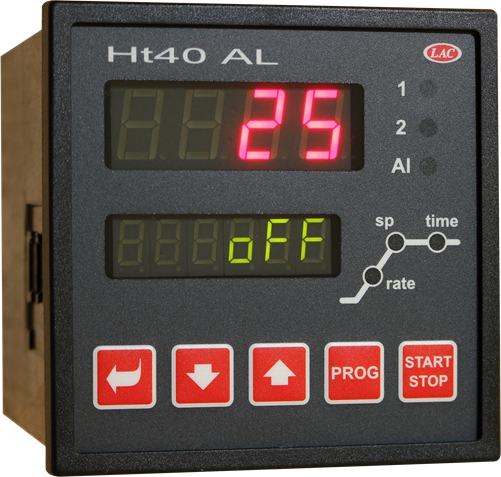
Ht40AL — simple and reliable firing control
The Ht40AL controller is designed for users who want straightforward operation and reliable everyday firing.
For beginners, simple operation is often more important than advanced programming options. A controller that feels easy to understand can make the first firing experience much less stressful.
- Simple programme setup
- Delayed programme start
- Reliable PID control
- Ideal for basic firing cycles
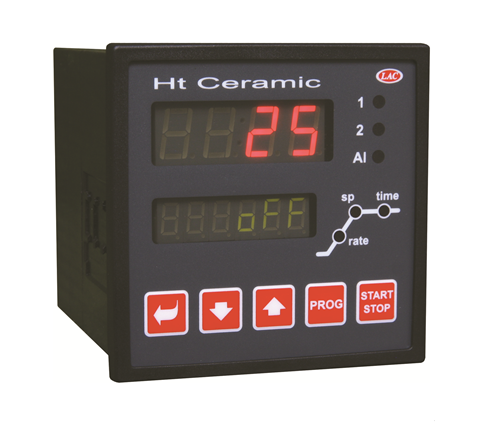
HtCeramic — when more control actually matters
The HtCeramic controller is intended for users who need more programmes, more firing steps and better repeatability.
This becomes useful when one kiln is used for different firing schedules, materials or repeated processes where the result should be consistent from one firing to the next.
- Up to 20 programmes
- Up to 15 steps per programme
- Data logging
- Suitable for complex firing curves
Why Wi-Fi and remote monitoring are becoming important
More users now expect the same convenience from kiln control that they already know from modern consumer electronics.
Many users know the situation — checking the kiln repeatedly late in the evening just to see whether the firing is progressing correctly.
Controllers with Wi-Fi connectivity allow users to monitor firing progress remotely, check the process from a smartphone or PC and store firing data.
Remote monitoring makes everyday operation significantly more comfortable, especially during long firing cycles.
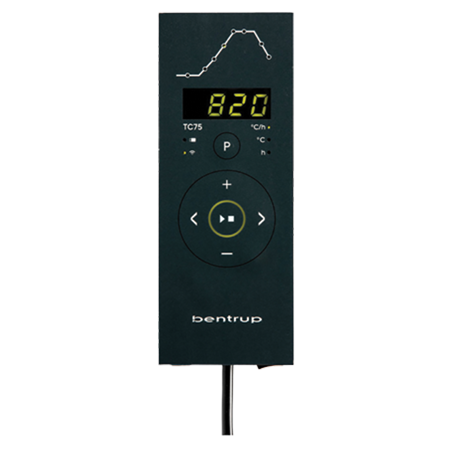
Bentrup TC75 — compact control with modern connectivity
The Bentrup TC75 combines simple operation with modern remote monitoring options.
It is suitable for users who want intuitive control, Wi-Fi access and a practical solution for everyday ceramic firing without unnecessary complexity.
- 6 programmes with 4 steps each
- Wi-Fi access via smartphone or PC
- USB interface
- Data logging for up to 48 hours
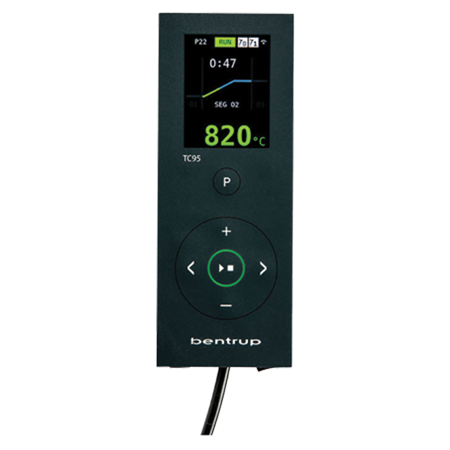
Bentrup TC95 — advanced control for professional firing
The Bentrup TC95 offers advanced programming flexibility, a graphic display and comfortable process visualization.
It is designed for demanding users who need more programmes, more firing steps and better control over repeated or complex firing schedules.
- 20 programmes with up to 20 steps
- Graphic LCD display
- Wi-Fi access via smartphone or PC
- Suitable for complex firing schedules
Why the controller affects firing quality
Accurate temperature control directly affects firing consistency and the final result.
If the firing curve is difficult to set, repeat or monitor, the user may spend more time checking the process — and still get less predictable results.
- Temperature stability
- Glaze quality
- Repeatable results
- Reduced risk of firing defects
A high-quality kiln needs a controller that matches the way it will actually be used.
Quick controller comparison
| Controller | Best for | Main advantage | Connectivity |
|---|---|---|---|
| Ht40AL | Basic firing cycles | Simple and reliable operation | HtMonit |
| HtCeramic | Advanced ceramic firing | More programmes and steps | HtMonit |
| Bentrup TC75 | Modern everyday use | Simple control with Wi-Fi access | Wi-Fi + USB |
| Bentrup TC95 | Professional firing | Advanced control and graphic display | Wi-Fi + USB |
Which controller is right for your kiln?
The right choice depends on how often the kiln is used, how complex the firing schedules are and how much control the user needs during the process.
For simple firing, simplicity may be the best feature. For professional use, flexibility and repeatability become much more important.
The question is not “Which controller has the most functions?” but “Which controller will make your firing easier, safer and more repeatable?”
Controllers are available as part of LAC ceramic kilns
The controllers described above are not sold separately. They are available as part of selected LAC ceramic kilns, especially the M top-loading kiln series, where the controller can be chosen according to the required firing process and level of control.
👉 Explore our ceramic kilns and controller options.
The best controller is the one that matches your real firing process.
Not every application requires the same level of control, flexibility or connectivity.
👉 Contact us and we will help you choose the right controller for your kiln.
What to remember
The kiln itself is only part of the firing process.
The controller determines how comfortably, accurately and repeatably the kiln will work in everyday operation.