
Melting or Holding Aluminium?
Melting or Holding Aluminium?
Crucible capacity alone is not enough—what matters is how much metal you need, when you need it and how it enters the furnace
The key difference:
Capacity tells you how much aluminium the furnace can contain. Melting output tells you how quickly it can provide additional molten metal. For production, these are two different requirements.
“We need a furnace for 500 kilograms of aluminium.” This sounds like a specific requirement, but it is not enough to select the correct furnace.
One foundry needs to melt a cold load in the morning and then add tens of kilograms of metal every hour throughout the shift. Another receives molten metal from a central melting plant and only needs to hold it at the casting machine. A third wants to melt a batch in one furnace, draw metal from it for several hours and replenish it as required.
All three operations may require a similar crucible capacity and the same operating temperature. However, the required heating power and production arrangement will be different.
The correct specification begins with the production metal balance, not the model size.
The first question: where does the molten metal come from?
| Production situation | Likely direction | What must be calculated or verified |
|---|---|---|
| Cold ingots, foundry returns or another solid load are placed in the furnace | Melting furnace | Required melting output in kg Al/h, initial condition of the load, required start-up melting time and ongoing metal withdrawals |
| Molten metal arrives from another furnace and must be held at the casting machine | Holding furnace | Required metal reserve, withdrawal rate, replenishment frequency, holding time and heat losses during operation |
| One furnace must melt a batch and then hold it | Melting and holding furnace | Peak melting requirement and long-term holding mode; both parts of the cycle must be assessed |
| A central melting plant supplies several casting stations | Combination of melting and holding furnaces | Total metal balance, molten-metal transport, reserve at each station and coordination with the casting machines |
This overview does not determine a specific model. It does, however, explain why two furnaces with the same capacity may not be interchangeable in the same production process.
Capacity in kilograms is not melting output
Technical specifications contain two values that customers sometimes confuse:
Capacity in kg Al indicates the amount of aluminium for which the furnace and crucible assembly is designed.
Melting output in kg Al/h indicates how much aluminium the furnace can melt per hour under specified conditions.
Capacity answers the question “How much metal can the furnace contain?” Melting output answers the question “How quickly can the furnace provide additional molten metal?”
If a casting station continuously consumes 100 kg Al/h while the furnace melts less than this in actual operation, the metal level will gradually fall. A large crucible will only conceal the difference temporarily. It cannot replace the missing melting output.
What must a melting furnace be able to do?
During melting, the furnace must heat the solid load, convert it into a liquid state and bring the molten metal to the temperature required for subsequent processing.
Its heating power is therefore not used solely to compensate for heat losses. It must also provide the energy required to heat and melt each new addition of metal.
When sizing a melting furnace, specify:
- how many kilograms of molten metal must be available at the beginning of the shift,
- how long the initial melting stage may take,
- how much metal is actually consumed per hour and per shift,
- whether withdrawals are continuous or occur in peaks,
- how often solid metal is added and in what quantities,
- which alloy is processed and which operating temperature range is specified by the process,
- the form and initial temperature of the material entering the furnace,
- the operating reserve required for breaks, product changes or fluctuations in casting-machine output.
The required melting output should not be calculated simply by dividing daily consumption by the number of operating hours.
If a large proportion of the metal must be ready before casting begins, or if metal is withdrawn unevenly, the most demanding part of the cycle determines the required performance.
What must a holding furnace be able to do?
A holding furnace performs a different task. The metal is already molten, and the furnace’s primary purpose is to maintain the required reserve at the temperature specified by the production process.
The heating system mainly replaces heat lost through the furnace casing and lid, as well as during furnace opening, dosing and replenishment.
When selecting a holding furnace, specify:
- how much metal must remain continuously available at the machine,
- how quickly molten metal is withdrawn and replenished,
- the temperature at which replenishment metal enters the furnace,
- how long and how often the lid remains open,
- whether metal is dosed manually or by automated equipment,
- where the control temperature is measured and whether direct measurement in the melt is required,
- how long the metal will remain in the furnace without being withdrawn, for example during breaks or between shifts.
A higher set temperature is not a substitute for insufficient capacity or melting output. The operating temperature must be based on the specific alloy and casting process.
Same capacity, different performance: the 500-size example
The difference can be demonstrated by comparing the electric LAC PTE Mk.II and PT Mk.II series.
According to LAC documentation, both size 500 models have a capacity of 480 kg Al and a recommended operating temperature range in the crucible of 650–850 °C. Their installed power and melting output, however, are different.
| Parameter | PTE 500/09 Mk.II | PT 500/11 Mk.II |
|---|---|---|
| Main purpose | Holding aluminium | Melting and subsequent holding |
| Capacity | 480 kg Al | 480 kg Al |
| Installed power | 27 kW | 61 kW |
| Stated maximum melting output | 50 kg Al/h | 175 kg Al/h |
The LAC datasheet also states that the melting-output values in the table are maximum values and that approximately 80% of the stated maximum is achieved during actual operation.
Initial operating estimate
Approximately 80% of the stated maximum would correspond to about 40 kg Al/h for the PTE 500/09 Mk.II and about 140 kg Al/h for the PT 500/11 Mk.II. The actual result must still be assessed according to the specific load, temperature and operating cycle.
This is why “we need a 500 kg furnace” says nothing about whether the furnace can support the required production rate.
Can a holding furnace also melt metal?
LAC documentation also lists the melting of aluminium and aluminium alloys among the applications of the PTE Mk.II series. This does not mean that the PTE is interchangeable with the PT Mk.II for regular production melting.
In a comparable size, the PTE has lower installed power and a lower melting output. It can therefore melt a smaller quantity of solid metal, but the customer must verify whether the melting rate corresponds to actual production consumption.
If the furnace must continuously replace large withdrawals of molten metal, the value in kg Al/h is what matters—not simply whether melting appears in the list of applications.
Can a melting furnace also hold metal?
According to LAC documentation, the electric PT Mk.II series is designed for both melting and holding aluminium and aluminium alloys. It has higher installed power for melting operation.
During holding, however, the full melting power is not required continuously.
PT Mk.II furnaces are therefore equipped with heating-power switching. Depending on the furnace size, this allows part of the installed heating system to be disconnected.
Installed power alone does not determine actual operating efficiency. The real melting time, holding time, temperature, lid-opening cycle and hourly energy consumption under stabilised conditions must be compared.
If the equipment will spend most of its operating time holding metal that has already been melted elsewhere, a dedicated holding furnace may make more sense. If it must quickly melt a cold load at the beginning of each shift and then hold the metal, the PT melting series may be more appropriate.
One furnace or separate melting and holding?
One melting and holding furnace can be practical for a smaller or batch-based operation. A single unit requires less space and eliminates the need to transport molten metal between furnaces. Production, however, becomes directly dependent on its melting output, capacity and availability.
A separate arrangement with central melting and a holding furnace beside the casting machine divides the two tasks. The melting furnace prepares the metal, while the holding furnace creates a reserve for the specific casting station.
Compare both arrangements according to:
- the number of casting stations,
- consumption at each station,
- the distance between the furnaces and casting machines,
- the number of operating shifts,
- available installation space,
- the required operating reserve.
Neither arrangement is universally better.
The lid is not a minor detail
Heat losses increase when the furnace is open. This difference is also visible in LAC operating data.
| PTE 500/09 Mk.II operating condition | Lid closed | Lid open |
|---|---|---|
| Metal at 700 °C | 3.6 kWh/h | 9.3 kWh/h |
| Metal at 800 °C | 4.6 kWh/h | 14.7 kWh/h |
These figures cannot be transferred directly to another model or production process without further assessment. They clearly demonstrate, however, that the time for which the lid remains open must be considered in both the technical design and operating-cost estimate.
The operating procedure affects energy consumption. Frequency of metal withdrawal, dosing method and coordination with the casting machine therefore belong in the furnace specification.
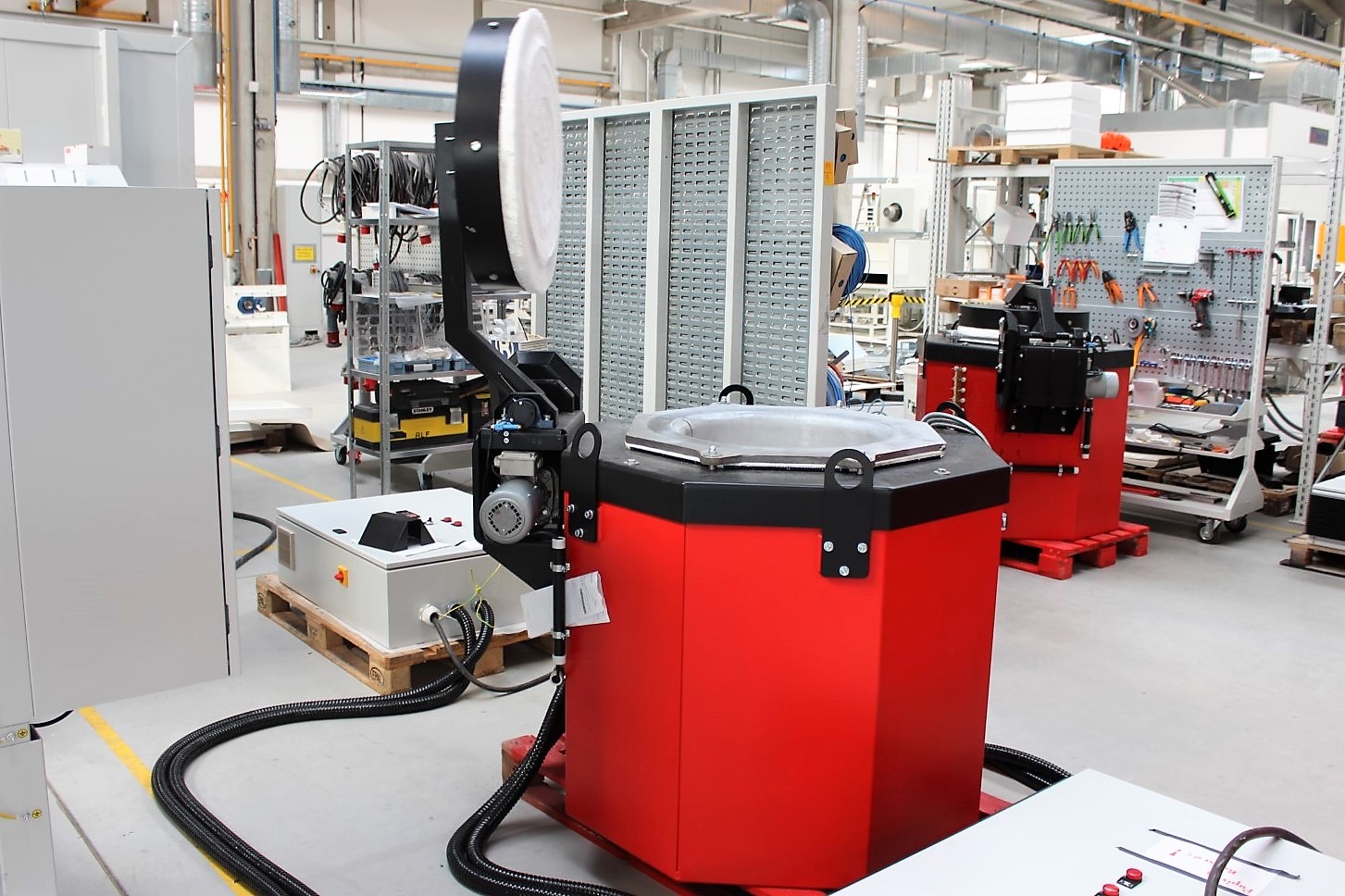
PT and PTE furnaces have a manually operated lid as standard. According to the datasheets, a pedal-controlled automatic lifting lid and preparation for connection to the dosing equipment of a casting machine are available as custom options.
If the furnace is intended to work as part of an automated production station, this requirement must be included in the specification from the beginning.
Furnace-chamber temperature and melt temperature are not the same
Standard furnace control may use a thermocouple installed in the furnace chamber. The temperature surrounding the crucible, however, is not automatically identical to the instantaneous temperature of the metal inside it.
According to LAC documentation, PT and PTE furnaces can be equipped at additional cost with a type K charge thermocouple in a protective tube inserted into the melt or with a thermocouple in the crucible wall.
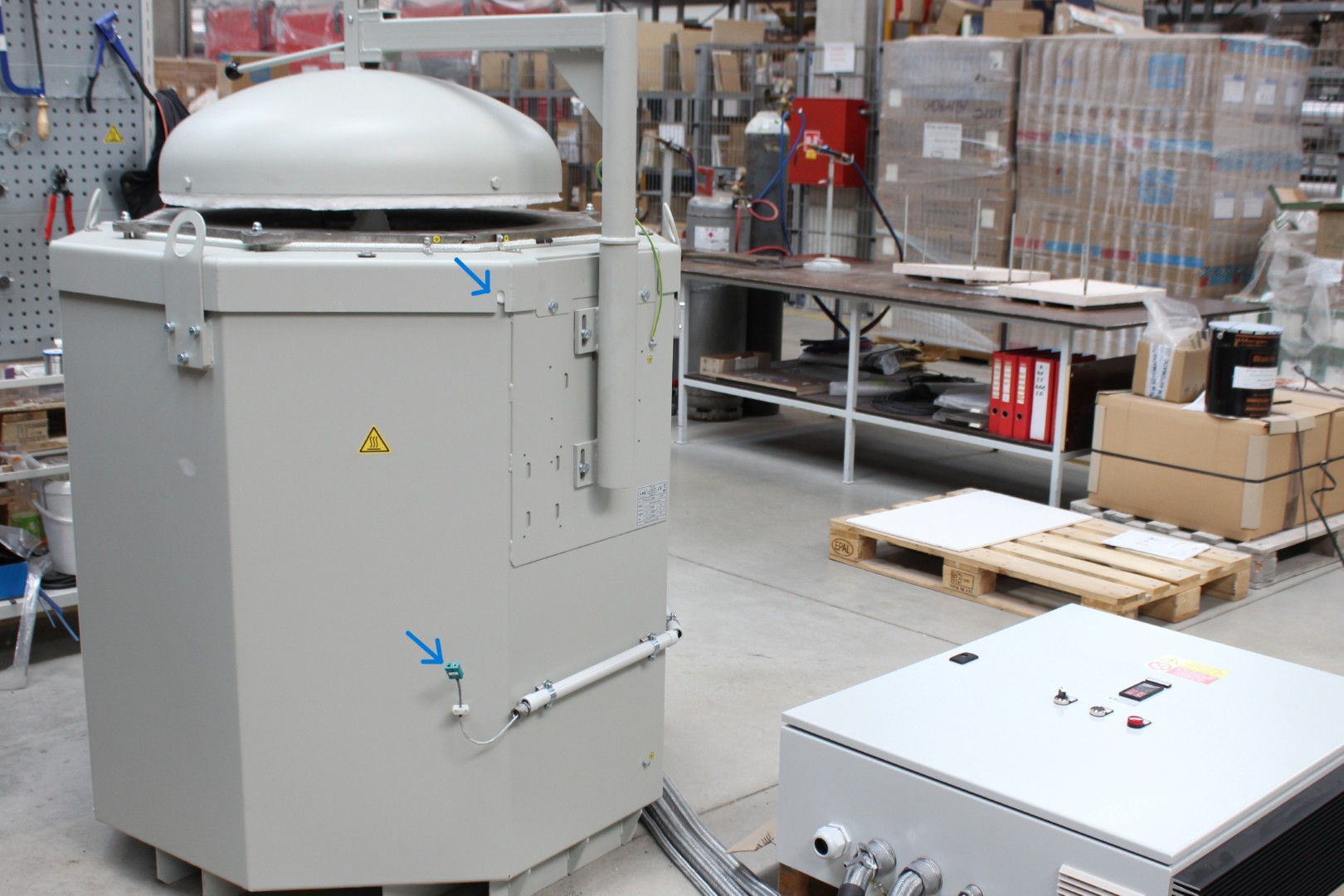
Your enquiry should state whether you only need to control the furnace or whether the melt temperature must also be monitored and recorded for production control.
Electric or gas-fired melting furnace?
The energy source is a separate decision.
The electric PT Mk.II series uses resistance heating and, depending on its size, provides switching between different levels of installed power. The LAC PTP gas-fired series uses a burner and is described in the documentation primarily as a melting furnace with a high melting output.
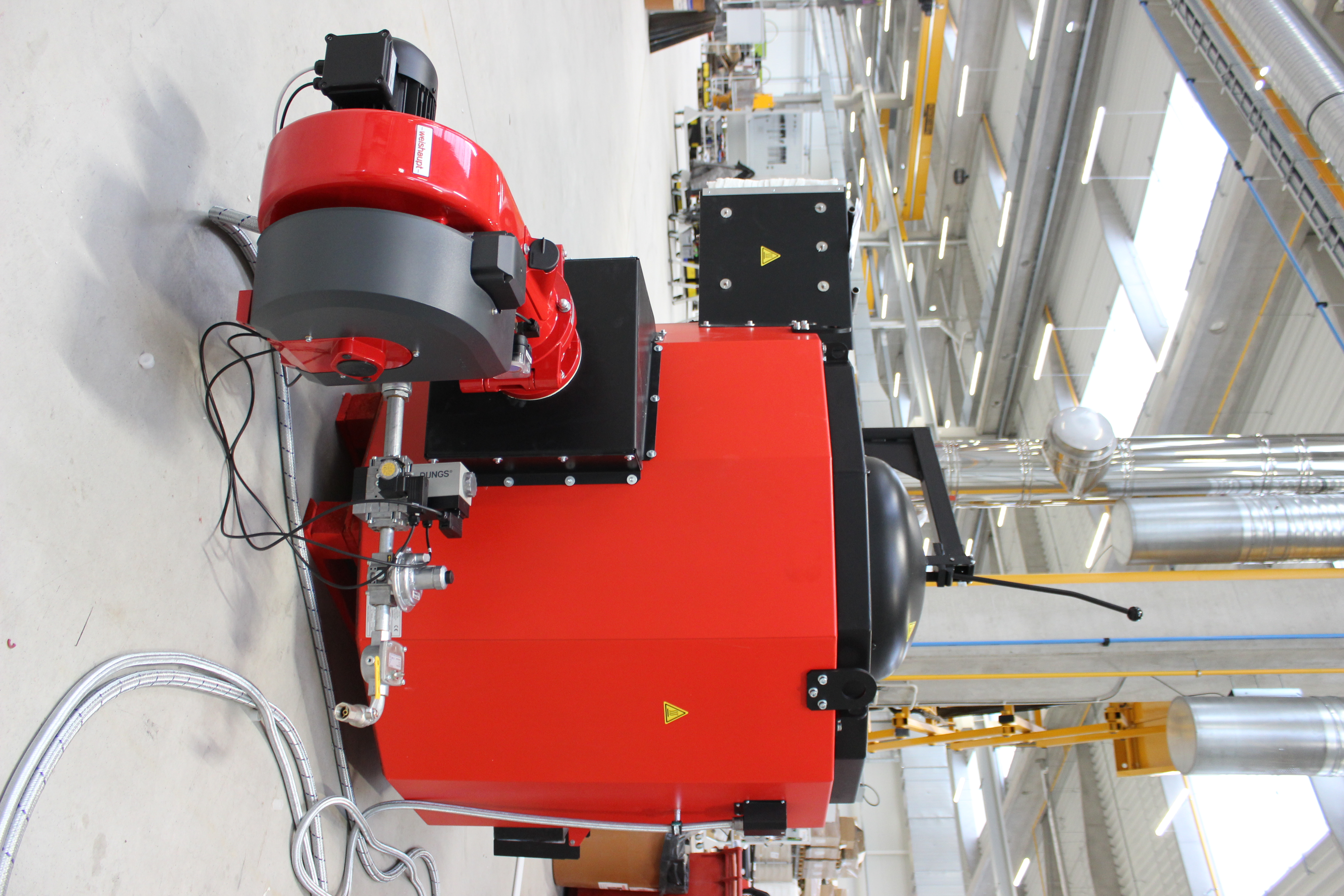
If a gas-fired PTP furnace is also intended for holding, the burner operating range must be modified so that it can run at low power. Do not assume that every gas-fired melting furnace is automatically suitable for long-term holding.
When comparing electric and gas-fired solutions, consider:
- the available electrical power,
- the type and parameters of the fuel supply,
- the required melting output,
- flue-gas extraction,
- available installation space,
- the control method,
- local energy prices.
A general claim that one energy source is always less expensive would be misleading.
The crucible affects both operation and maintenance
The crucible is a working and consumable component of the furnace. LAC datasheets draw attention to its limited service life, the need for regular inspection and the handling equipment required for replacement.
For larger sizes, a crane and suitable lifting tongs may be necessary.
Before purchasing the furnace, verify:
- the crucible type and capacity for the selected alloy,
- whether the crucible is included in the delivery—in the standard PT, PTE and PTP configurations, it is not included according to the documentation,
- the space above the furnace and the handling route required for crucible replacement,
- the availability of lifting equipment and appropriate tongs,
- inspection intervals based on actual operation,
- whether a crucible crack-detection system is required,
- the emergency-drain design and workplace requirements in the event of a molten-metal leak.
An emergency drain reduces the risk of damage to the equipment if metal escapes from the crucible. It does not replace crucible inspections, maintenance or the operating and safety procedures of the foundry.
Common selection mistakes
“Model 500 means 500 kilograms of metal per hour”
The number in the model designation refers to its size or capacity, not its hourly melting output. The melting output must be verified separately in kg Al/h.
“If the metal fits inside the crucible, the furnace is large enough”
Capacity determines the size of the available metal reserve. If the withdrawal rate exceeds the practical melting output, production will gradually consume that reserve.
“We can use the maximum melting output directly in the production plan”
The LAC datasheet states that approximately 80% of the specified maximum melting output is achieved during actual operation. The necessary reserve must be determined according to the specific load and cycle.
“A holding furnace cannot melt at all”
According to LAC documentation, the PTE Mk.II can also melt aluminium. What matters is its lower melting output and whether this is sufficient for the required production rate.
“A melting furnace must use its full installed power throughout holding”
Installed power is not the same as instantaneous energy consumption. The PT Mk.II series provides switching between heating-power levels, while its control system regulates the heating according to the required temperature.
“Leaving the lid open will not make a significant difference to consumption”
LAC data show a substantial difference between operation with the lid open and closed. The operating procedure must therefore form part of both the technical and economic specification.
“We can use a gas-fired melting furnace for holding without modification”
The PTP series requires a modification to the burner’s operating range for holding operation. This requirement must be known before the furnace is ordered.
What to include in your enquiry
To distinguish correctly between a melting and holding furnace, provide:
- the exact designation of the aluminium alloy or alloys,
- the form of the incoming load and its normal initial temperature,
- the required operating temperature of the molten metal,
- the quantity of metal required at the start of production,
- the required initial melting time,
- metal consumption in kg Al/h and kg Al per shift,
- the withdrawal profile, including short-term peaks,
- the size and frequency of replenishment batches,
- whether solid or molten metal is added,
- the number of shifts and the time for which the metal is only held,
- the required operating reserve,
- the method used to withdraw and dose the metal,
- whether connection to a casting machine or higher-level control system is required,
- whether direct melt-temperature measurement and data recording are required,
- the available electrical power or fuel parameters,
- the installation space, loading height and available crucible-handling equipment,
- requirements for extraction, flue-gas removal and workplace safety.
If you do not yet know the required melting output, provide a timeline for the production shift: how many kilograms must be available at the beginning, how much metal is withdrawn and when, and what type of material is used to replenish the furnace.
Explore LAC aluminium melting and holding furnaces
👉 View LAC PTE Mk.II electric holding stationary furnaces
👉 View LAC PT Mk.II electric melting stationary furnaces
Do not choose a storage vessel. Choose a source of molten metal that matches your production rhythm.
Tell us how much metal must be available, when it is required, how quickly it is withdrawn and whether replenishment material enters the furnace as solid or molten aluminium. This makes it possible to assess the required capacity, melting output and production arrangement.
What to remember
A holding furnace is appropriate when molten metal is already available and needs to be kept ready for production. A melting furnace is required when the equipment must produce new molten metal from a solid load.
Do not select the furnace by crucible capacity alone. Match its melting output, reserve and operating mode to the actual rhythm of your casting process.