
Heat Treatment in Air or a Protective Atmosphere?
Heat Treatment in Air or a Protective Atmosphere?
The required surface condition, material and complete operating cycle determine the correct furnace design
The key question:
What is allowed to happen to the product surface during heating and cooling? This often determines whether air is sufficient or whether a controlled atmosphere is needed.
A component reaches the specified hardness after heat treatment, but its surface is covered with scale and must be blasted before the next operation. The same surface change would make another product unacceptable. A third component will be fully machined after heating, so the cost of a protective gas would provide no benefit to the customer.
The temperature and holding time may be identical in all three cases. The difference lies in the required condition of the product surface. This often determines whether a furnace operating in air is sufficient, whether partial protection inside a working container makes sense or whether the process requires a gas-tight retort with a defined atmosphere.
A protective atmosphere is not automatically a better solution for every process. It increases technical complexity, consumes gas and creates additional requirements for tightness, purging, control and safety.
The first question: what is allowed to happen to the surface?
| Customer requirement | Likely direction | What must be verified |
|---|---|---|
| Oxidation and discolouration are acceptable, or the surface will subsequently be machined or blasted | Heat treatment in air may be sufficient | Material, temperature, cycle duration and permissible surface changes |
| Only limited exposure to air is required and a moderate improvement in surface condition is sufficient | A working container or semi-gastight configuration may be an option | The actual level of protection expected; partial protection does not provide the same conditions as a gas-tight retort |
| The surface must be protected in a defined environment throughout the process | Gas-tight retort furnace with a controlled supply of an appropriate gas | Material, gas, purity, flow rate, purging, temperature, cooling and permissible residual oxygen level |
| The atmosphere is intended to modify the surface chemically | Process using a reactive gas and specially designed equipment | Process chemistry, gas safety, measurement and required surface layer |
| Heat treatment under vacuum is required | Dedicated vacuum technology | Required pressure, temperature, pumping system, materials inside the chamber and process cleanliness |
This table provides an initial guide only. The final choice must not be based solely on the appearance of the surface. Mechanical properties, possible changes to the surface layer, gas safety and production repeatability are also important.
What happens when metals are heated in air?
Air contains oxygen and moisture. Heating metals in air can therefore cause oxidation, scale formation and colour changes. Under certain conditions, the carbon content of the surface layer of steel may also change.
The extent of these changes depends on the material, temperature, time at temperature, initial surface condition and atmosphere circulation.
Processing in air can be suitable when:
- the formation of an oxide layer is acceptable,
- heat treatment is followed by machining, blasting or another operation that removes the affected surface,
- the surface change does not affect the product’s function,
- the process itself requires an oxidising environment,
- the benefit of a protective atmosphere would not justify its technical and operating requirements.
“The appearance does not matter” is not always enough. If the altered surface layer could affect hardness, dimensions or service life, its acceptability must be assessed by the process engineer.
What is a protective atmosphere?
A protective atmosphere creates an environment around the load that is intended to limit undesirable reactions with the surrounding air. Depending on the furnace configuration, LAC equipment can use gases such as nitrogen, argon or forming gas.
The correct gas should not be selected solely according to its price or because it is already used in another production process.
The result depends on the entire system:
- the tightness of the working space,
- the quantity of air remaining before heating begins,
- the purging method and duration,
- the purity and composition of the supplied gas,
- the gas flow rate during the process,
- substances released from the load, fixtures and product surfaces,
- the operating temperature and holding time,
- the point at which the furnace is opened or the protective environment is discontinued,
- the product cooling method.
Simply connecting a nitrogen cylinder does not guarantee a defined environment or a particular surface quality.
Nitrogen, argon and forming gas are not interchangeable
Nitrogen and argon are commonly used for protective atmospheres. Their suitability, however, depends on the processed material, operating temperature and required result. A gas that provides sufficient protection for one application may be unsuitable for another material or temperature.
Forming gas is a mixture containing hydrogen. Its exact composition must be stated in the specification because it affects both the process and equipment safety. It cannot be assumed that every mixture described by this general name can be connected to every furnace.
Flammable or reactive gases require appropriate design and safety measures. A standard configuration intended for a non-flammable protective gas must not be used with hydrogen, ammonia or another hazardous atmosphere without a technical assessment.
Protective and reactive gases perform different tasks
The main purpose of a protective gas is to limit undesirable changes to the product surface. A reactive atmosphere, by contrast, participates intentionally in the process.
Examples include nitriding and carbonitriding, in which the material’s surface layer is deliberately modified.
“We want nitrogen to prevent oxidation” and “we need a nitriding process” are two different technical requirements.
Processes using reactive gases require the technology, dosing system, safety measures, gas extraction and process control to be designed as a complete system.
Three levels of protection that must not be confused
1. Gas supply to a standard or semi-gastight furnace
With some chamber furnaces, exposure to ambient air can be reduced and a protective gas introduced. However, the LAC PK datasheet explicitly states that a semi-gastight configuration with a working container provides only partial protection of the load and is not equivalent to a gas-tight furnace.
This solution may be suitable when the customer accepts a limited degree of protection. However, it must not be sold or ordered with an undefined promise of a perfectly clean or bright surface.

2. Working container with an atmosphere supply
A working container separates the load from most of the space inside a standard furnace and may reduce gas consumption. Its actual effectiveness depends on the design, closure, purging method, container material and operating cycle.
LAC documentation presents working containers as a possible solution for hardening in a protective atmosphere with PK and PKE furnaces. However, the furnace and container must be designed as one specific assembly.

3. Gas-tight retort furnace
A gas-tight retort creates a separate process space with an atmosphere inlet and outlet. It enables the purging procedure and process flow to be controlled and provides a more clearly defined environment than a semi-gastight configuration.
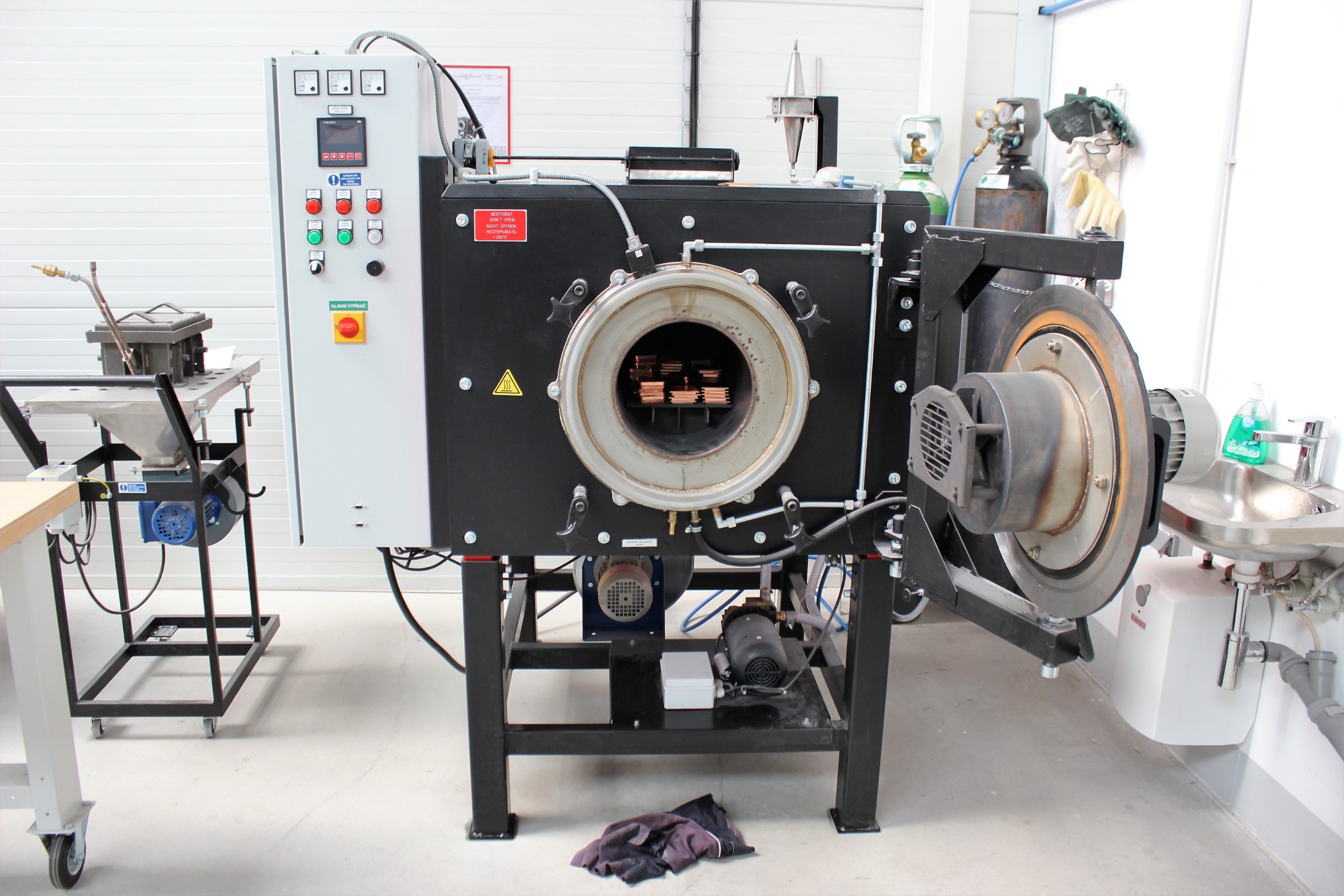
Even a retort furnace cannot guarantee a particular surface appearance under all circumstances. The result is still affected by the gas, residual oxygen, contamination on the load, heating and cooling profiles, and the condition of the retort itself.
A vacuum pump on a retort does not make it a vacuum furnace
Some LAC retort furnaces can be equipped with a vacuum pump to remove the original atmosphere before the protective gas is introduced. This can improve the exchange of atmosphere inside the retort.
Pre-evacuation before introducing protective gas is not the same as heat treatment under vacuum.
A vacuum furnace is designed for a specified operating pressure, temperature, pumping system, tightness level and set of materials inside its hot zone. If the customer requires a vacuum process, the required pressure and operating cycle must be specified. It cannot be replaced by a general request to “add a vacuum pump”.
How the requirement relates to the LAC portfolio
Product series cannot be assigned to processes mechanically. The following overview indicates a possible design direction, not a final selection of a specific model.
Processes in air: PK, PKE and PP
PK and PKE chamber furnaces are designed for processes including hardening and annealing metal materials. The standard PK furnace operates in an oxidising atmosphere.
PP tempering furnaces use forced circulation of the internal atmosphere and cover tempering as well as selected annealing processes.
If surface oxidation is acceptable, these designs may provide the technically and operationally simplest solution.
PKR and PKRC gas-tight chamber furnaces
The PKR and PKRC series have a gas-tight retort and an automatically controlled inlet for one type of protective atmosphere as part of their standard equipment. The PKRC additionally provides internal atmosphere circulation.
Depending on the retort material, the furnaces are available for maximum temperatures of 950 or 1100 °C. The suitability of the higher-temperature configuration and the expected retort service life must be assessed according to the actual operating cycle.
PZ bell furnaces
PZ gas-tight bell furnaces use internal atmosphere circulation and bottom loading. They are designed for large and heavy loads that benefit from handling at floor level.
The series is available in versions with maximum temperatures of 650 or 850 °C.
SRC shaft furnaces
SRC gas-tight shaft furnaces are intended for large and heavy loads inserted using a crane. They have a retort, an automatically controlled protective-atmosphere inlet and forced circulation of the internal atmosphere.
Depending on the retort material, they can be configured for maximum temperatures of 950 or 1100 °C.
The choice between a chamber, bell or shaft design is not determined by the atmosphere alone. The dimensions, weight and orientation of the load, handling method and required production capacity are also important.
A retort has its own operating limits
A retort is exposed to thermal and chemical stresses. Its material, operating temperature, holding times, number of cycles and cooling method all affect its service life.
A higher maximum furnace temperature does not automatically mean that the standard retort is suitable for operation at the same temperature.
For the PKR, PKRC and SRC series, LAC distinguishes between a standard heat-resistant steel retort and a higher-temperature version made from an Inconel-type material. The correct choice must be based on the normal operating temperature, not only on the highest temperature that the equipment is expected to reach briefly.
In addition to gas consumption, process costs may include cooling of the seal or retort collar, maintenance of the gas supply system and eventual retort replacement.
These costs should be compared with the cost of blasting, surface machining and rejected products when heat treatment is performed in air.
Common selection mistakes
“We will introduce nitrogen into a standard furnace and have a protective atmosphere”
Without appropriate tightness, purging and controlled gas flow, the resulting atmosphere is difficult to define. A gas inlet is not the same as a gas-tight process space.
“A semi-gastight furnace is simply a less expensive gas-tight furnace”
These configurations provide different levels of protection. A semi-gastight design may reduce contact with air, but it cannot automatically be assigned the same parameters as a retort furnace.
“Argon always produces the best surface”
The suitability of an atmosphere depends on the material, temperature, gas purity, furnace tightness and contamination within the load. The name of the gas alone does not determine the result.
“A protective gas will remove existing scale”
A protective atmosphere is intended to prevent or limit changes during the relevant cycle. It does not automatically restore an already damaged or oxidised surface to its original condition.
“A vacuum pump turns a retort furnace into a vacuum furnace”
Removing the original atmosphere before introducing a gas and performing heat treatment under a defined vacuum are different requirements. A vacuum process requires its own technical specification.
“Protection is only required during the holding phase”
The surface may react during heating and again during cooling. The specification must define during which parts of the cycle the protective atmosphere must be maintained and at what temperature the equipment may be opened.
What to include in your enquiry
To select between processing in air and a controlled atmosphere, provide:
- the exact material designation,
- the initial condition and cleanliness of the surface, including oils and residues from previous operations,
- the required heat-treatment result,
- a description of acceptable and unacceptable surface changes,
- the operating temperature, holding time, heating rate and complete cooling cycle,
- the dimensions and weight of one component and the complete load,
- a drawing or photograph of the loading arrangement and the fixture materials,
- the required temperature uniformity,
- the proposed gas type, its exact composition and available purity,
- the pressure and capacity of the factory gas supply or the proposed cylinder supply,
- the required purging sequence and process flow, if these have been specified by the process engineer,
- permissible oxygen, moisture or other atmosphere parameters, where prescribed,
- all substances that may be released from the load during heating,
- whether cooling under a protective atmosphere is required,
- the temperature at which the product needs to be removed,
- the number of cycles per shift and the handling method,
- vacuum or reactive-gas requirements as separate items,
- safety regulations and gas-extraction facilities at the installation site.
If you do not yet know which gas is suitable, begin by describing the material, surface condition and expected result. Do not specify nitrogen or argon simply because another facility uses it.
Explore LAC furnaces for controlled atmospheres
👉 View LAC PKR gastight chamber furnaces
👉 View LAC PKRC gastight chamber furnaces with internal atmosphere circulation
Do not pay for gas without a clear reason. Do not risk a surface that matters.
Describe the material, operating cycle and the surface condition that is acceptable after heat treatment. This makes it possible to assess whether processing in air is sufficient or whether a working container, semi-gastight configuration or gas-tight retort furnace is required.
What to remember
Processing in air may be entirely appropriate if surface changes are acceptable or will be removed afterwards. A protective atmosphere is justified when it solves a specific surface or process requirement.
Do not begin with “we need a nitrogen furnace”. Begin with the material, process and a clear definition of what may and may not happen to the product surface.