
Annealing, Hardening and Tempering: The Basic Differences
Annealing, Hardening and Tempering: The Basic Differences
Do not choose a furnace by the process name until you know which material property you need to change
The key principle:
Annealing, hardening and tempering are not interchangeable names for heating steel. Each process has a different purpose, temperature profile and cooling method.
One component is too hard for further machining. Another becomes distorted during hardening. A tool has reached the required hardness but cracks during use. Heat treatment may form part of the solution in all three cases, but the required process will be different each time.
In hardening, the result is not produced inside the furnace alone: transferring the heated component and cooling it in an appropriate quenching medium are also essential parts of the process.
It is therefore not enough to write “we need a heat-treatment furnace” or “a furnace up to 1,000 °C” in your enquiry. The furnace manufacturer needs to know what material the component is made from, its initial condition and the properties it must have after the complete process.
This article explains the basic differences using steels as an example. The specific heat-treatment cycle must always be based on the documentation for the particular material grade and the requirements defined by the process engineer.
Begin by defining the required result
| Production problem | Likely direction | What must be known before choosing a furnace |
|---|---|---|
| The component is too hard for further machining or forming | An appropriate annealing process | Material grade and initial condition, required machinability or structure |
| Internal stresses must be reduced after welding or machining | Stress-relief annealing | Material, dimensions, previous operations and acceptable changes in properties |
| The hardness of a hardenable steel must be increased | Hardening, usually followed by tempering | Steel grade, component cross-section, austenitising cycle, quenching medium and permissible distortion |
| The hardened component is too brittle, or a specific balance between hardness and toughness is required | Tempering | Condition after hardening, required hardness and mechanical properties |
| Only internal stresses need to be relieved and the component has not been hardened | Do not automatically describe the process as tempering | A process engineer must specify the correct annealing process and cycle |
This table provides only an initial guide. The term annealing covers several different processes, and two steels used for the same general application may still require different temperature cycles.
What is annealing?
Annealing is a group of heat-treatment processes in which the material is heated to a specified temperature, held there for a defined period and then cooled under controlled conditions. The purpose depends on the particular type of annealing.
In practice, it may be used to:
- reduce internal stresses after welding, forming or machining,
- soften material for further machining or forming,
- recrystallise material after cold working,
- homogenise its structure or chemical composition,
- create the structure required for a subsequent production operation.
Annealing cannot always be described simply as “heating the material and allowing it to cool slowly”. The cooling method and cooling rate are part of the specific annealing process. The temperature, holding time, initial material condition and component dimensions are equally important.
When does a customer actually need annealing?
A typical enquiry does not begin with the words “we want to anneal”. It usually begins with a production problem: a component distorts after it is removed from a fixture, a welded structure changes shape, the material is difficult to machine or its structure must be prepared for another heat-treatment operation.
Do not provide only the name of the proposed annealing process. Describe the previous production operation and the required condition after heat treatment.
Only then is it possible to determine whether the necessary cycle falls within the capabilities of a particular furnace.
What is hardening?
When hardening steel, a suitable hardenable grade is first heated to the temperature specified for forming the required austenitic structure. The component is allowed to heat through and is then cooled quickly enough to produce the required hardened structure.
The correct cycle depends, among other factors, on the steel’s chemical composition and hardenability, as well as the component’s cross-section and shape.
Hardening is a complete process chain:
- Heating without an unacceptable temperature overshoot.
- Heating the actual component through, rather than merely reaching the set temperature inside the furnace.
- Holding for the period specified by the heat-treatment procedure.
- Removing the load and transferring it to the quenching medium.
- Cooling it at the required rate and with sufficient uniformity.
- Performing the subsequent tempering operation, where specified.
The furnace alone cannot guarantee the hardening result. Appropriate handling equipment, transfer time and a correctly designed quenching station are also part of the process.
Not every steel hardens in the same way
Two components with identical dimensions may require different cycles if they are manufactured from different steel grades. The same steel can also behave differently in thin and heavy sections of the same product because their cooling rates are different.
It is therefore risky to request a “universal furnace for hardening every type of steel” without defining the intended product range.
The furnace may cover the required temperatures, but the process must also account for the material, cross-section, quenching medium, transfer time and required result.
What is tempering?
Tempering usually follows hardening. The hardened steel is reheated to a temperature lower than the temperature used for hardening, held according to a specified cycle and then cooled.
The purpose is to modify the hardened structure, reduce brittleness and internal stresses, and achieve the required balance between hardness, strength and toughness.
A reduction in hardness after tempering is not automatically a defect. The hardest possible component may not provide the longest service life if it is also excessively brittle.
The tempering temperature and number of cycles depend on the specific steel grade and heat-treatment procedure. Repeated tempering may be prescribed for certain tool steels.
However, without knowing the material and required properties, the furnace manufacturer should not create a universal heat-treatment recipe.
Why hardening and tempering belong in the same specification
Customers sometimes request only a hardening furnace and begin considering the subsequent operation at a later stage. This can result in a workplace that heats the components correctly but cannot provide the required capacity for the complete process.
Answer these questions during the initial design stage:
- How soon after hardening must tempering begin?
- How many loads from the hardening furnace will be waiting for one tempering furnace?
- How long does the tempering cycle take?
- Will different programmes be required for different materials?
- How will the hot load be handled between the individual pieces of equipment?
- Is the process capacity limited by the furnace, quenching medium, handling system or subsequent tempering operation?
The largest possible furnace chamber does not necessarily increase production output. If the load cannot be transferred and quenched safely in the required time, or if no tempering furnace is available afterwards, the bottleneck will occur outside the heating stage.
The controller temperature is not automatically the component temperature
The control thermocouple monitors the temperature at a particular position inside the furnace. A heavy load, however, heats with a delay, and its core may be at a different temperature from the atmosphere in the working space.
This is particularly important when determining the beginning of the holding time. If the programme starts the holding phase as soon as the furnace controller reaches its setpoint, the entire load may not yet have heated through.
Conversely, keeping some materials at temperature for too long may also be undesirable.
The specification should therefore include the load weight, dimensions and arrangement, as well as whether the temperature of a representative component needs to be measured.
The third article in this series examined the difference between furnace temperature and actual load temperature in more detail.
How these processes affect the choice of a LAC furnace
The product-series name is a guide, not a substitute for a technical assessment. One furnace may be suitable for several processes, while the same process may require different equipment depending on the load.
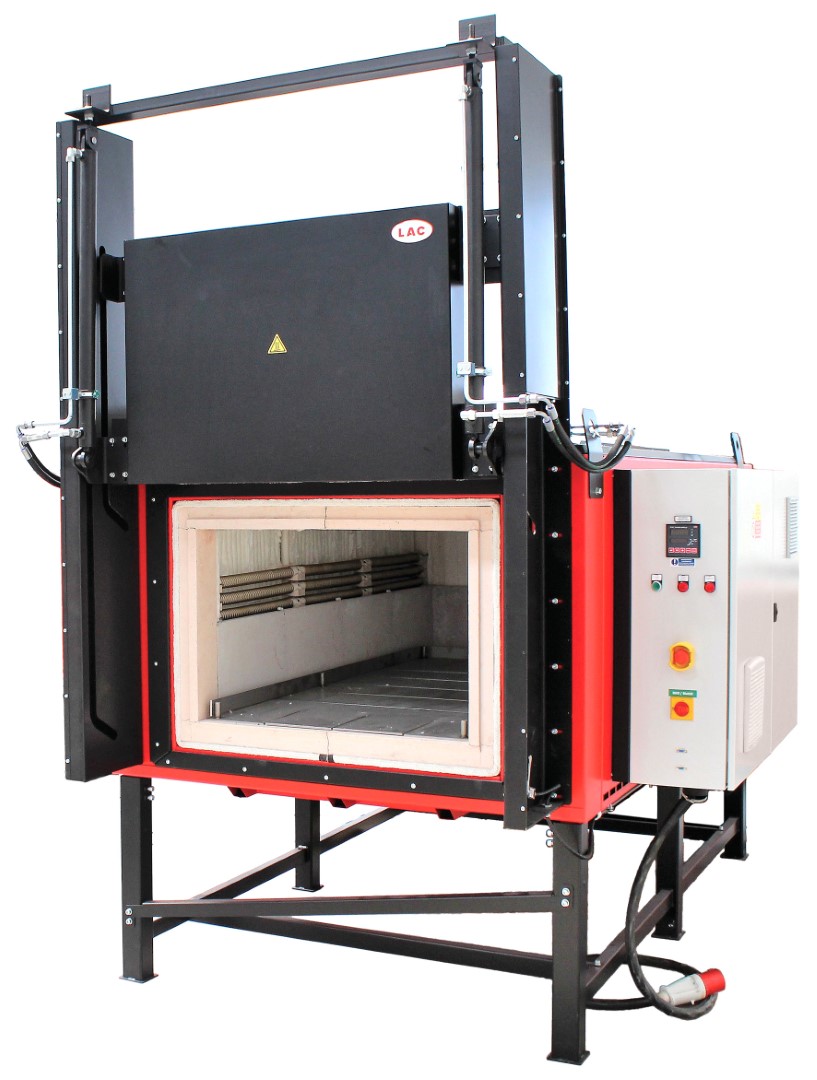
PK hardening chamber furnaces
The LAC PK series is designed for hardening, annealing or preheating metal loads in an oxidising atmosphere. The furnaces have a maximum temperature of 1280 °C and a recommended operating temperature range of 700–1200 °C.
Their robust construction and three-sided heating are designed for industrial operation. Depending on the specific workplace, suitable handling and quenching equipment can also be included in the proposed solution.
Smaller PKE hardening chamber furnaces
The PKE series is a smaller alternative for lighter loads that are normally handled manually. These furnaces also reach a maximum temperature of 1280 °C and are listed in the datasheet for hardening, annealing and other heat-treatment processes.
Their suitability depends on the required cycle, load weight and frequency of use.
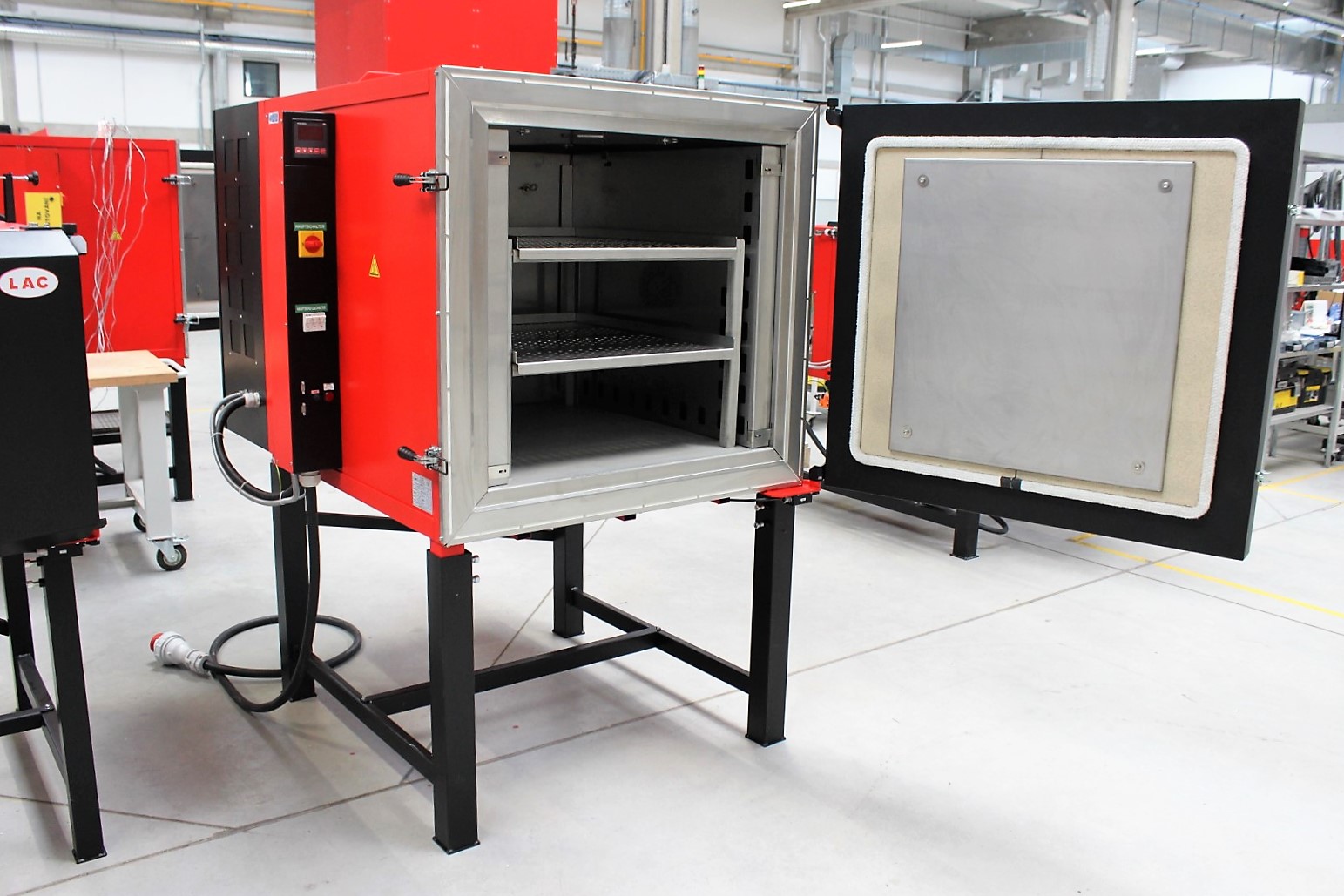
PP tempering furnaces with forced circulation
The PP series is available with maximum temperatures of 650 or 850 °C. Depending on the version, the recommended operating temperature range is 200–600 °C or 300–800 °C.
Horizontal forced circulation helps transfer heat to the load and equalise the temperature within the working space. The datasheet lists both high- and low-temperature tempering, as well as selected annealing processes, among the applications of this series.
A PP furnace cannot automatically replace a hardening furnace. If the process requires a higher austenitising temperature followed by rapid cooling outside the furnace, the corresponding quenching section of the workplace must also be designed.
Air can affect the product surface
When steel is heated in air, surface oxidation and, depending on the conditions, other undesirable changes in the surface layer may occur. Whether these changes are acceptable depends on the product and any subsequent processing.
If the product surface needs to be protected, state this requirement in the initial enquiry. A semi-gastight configuration or working container provides different conditions from a furnace with a gastight retort. These solutions must not be treated as equivalent.
The next article in this series will examine the choice between processing in air and using a protective atmosphere.
Common mistakes in the specification
“We know the temperature, so we have selected the furnace”
Different processes may use the same temperature. The holding time, heating and cooling rates, atmosphere, temperature uniformity, load and handling method must also be considered.
“The holding time begins as soon as the controller reaches the setpoint”
The controller measures the furnace space at the position of its thermocouple. A heavy or large component may need additional time to heat through. The method used to determine the beginning of the holding time must be specified by the heat-treatment procedure.
“The process is finished after hardening”
A hardened component may be very hard while also being brittle and subject to high internal stresses. If tempering is required by the material specification, it is part of the complete process rather than an optional improvement.
“The highest hardness produces the best component”
The correct combination of properties is the one that corresponds to the product’s intended function. Greater hardness may be accompanied by lower toughness and a higher susceptibility to failure.
“The furnace alone performs the hardening process”
The furnace provides heating and holding. However, the hardening result is also strongly influenced by the transfer operation and cooling in the specified quenching medium. The complete workplace must be considered during the design stage.
“We can use one programme for every steel”
Different steel grades, cross-sections and initial conditions may require different temperatures, holding times and cooling methods. Each programme must be based on the applicable material and heat-treatment specification.
What to include in your enquiry
To select the appropriate furnace, provide:
- the material designation according to the relevant standard or supplier documentation,
- the material’s initial condition and previous production operations,
- the required type of heat treatment,
- the required hardness or other final properties,
- the specified operating temperature, heating rate, holding time and cooling method,
- the dimensions, shape and weight of one component,
- the maximum number of components and total load weight,
- a drawing or photograph of the loading arrangement and information about any fixtures,
- the required temperature tolerance and the space across which it must apply,
- requirements for process recording or load-temperature measurement,
- the quenching medium, cooling method and required transfer time,
- requirements for surface protection or a protective atmosphere,
- the number of cycles per shift and the relationship between the hardening and tempering capacities.
If some of this information is not available, provide at least the material datasheet, component drawing and a description of the problem that the heat-treatment process must solve.
The final heat-treatment cycle must be confirmed by the specialist responsible for the material and product.
Explore LAC heat-treatment furnaces
👉 View LAC PK hardening chamber furnaces
Do not buy “a hardening furnace”. Design the complete process.
Describe the material, its initial condition, required properties, temperature programme, atmosphere, loading arrangement, transfer method, quenching medium and required production capacity. Only this information makes it possible to select the appropriate furnace or equipment system.
What to remember
Annealing modifies the material’s structure, internal stresses or processability depending on the specific method used. Hardening produces a hardened structure through controlled heating and sufficiently rapid cooling. Tempering then adjusts the properties of the hardened component and reduces brittleness and internal stresses.
First define the material, its initial condition and the required final properties. The furnace selection comes afterwards.