
When Is an EN 1539 Industrial Oven Required?
When Is an EN 1539 Industrial Oven Required?
What the load releases during heating matters more than the operating temperature alone
The key question:
Do not ask only “At what temperature will we dry?” Ask first “What can be released from the load during heating, and in what maximum quantity?”
You need to dry painted components at 120 °C. The load fits inside a standard industrial oven and the specified temperature range is suitable. Does this mean you can order the standard configuration?
Not yet.
If the paint, adhesive, impregnation resin or cleaning agent contains solvents or other flammable components, flammable vapours may be released during heating. In that case, selecting an oven according to its chamber volume and temperature range is not enough. The process must be assessed and the safety configuration designed according to the substances released and their quantities.
This is the area covered by EN 1539, the European standard for dryers and ovens in which flammable substances are released during the evaporation and curing of coating materials.
This does not mean that every drying process automatically requires the same configuration. The actual contents of the load and the complete process determine what is required.
The first question is not “At what temperature?” but “What will evaporate?”
Customers often describe the product in a single sentence: “The component is wet and needs to be dried.” For the equipment design, however, there is a fundamental difference between water and a flammable solvent.
| Production situation | What it means for equipment selection | What must be verified |
|---|---|---|
| Only water evaporates from the product | An EN 1539 configuration may not be required for water evaporation alone | Whether the load contains any other hazardous substances and how much moisture must be removed |
| Components carry solvent-based paint, adhesive, impregnation resin or cleaning-agent residue | The release of flammable substances and the corresponding safety solution must be assessed | Safety data sheets, quantity of the substance in the load, operating temperature and release profile |
| The composition of the product or its residual quantity is unknown | It cannot safely be assumed that a standard industrial oven will be sufficient | Information from the chemical supplier and the actual condition of the product when loaded |
| The paint, adhesive, cleaner or batch size changes during production | The original assessment may no longer be valid | New composition, maximum load and temperature programme |
Equipment suitability is not determined by the product’s trade name or whether the component feels dry to the touch. Solvent can remain inside a coating or product and may not be released until the temperature rises.
What does EN 1539 cover?
EN 1539 addresses significant hazards associated with dryers and ovens in which flammable substances are released through evaporation or during the curing of coating materials.
Its purpose is to prevent a hazardous concentration from forming inside the equipment and to ensure that the failure of an important safety function does not allow heating to continue without the required operating conditions.
EN 1539 is not “one extra fan”
The safety concept includes the oven design, controlled air exchange, monitoring of fan operation, temperature limitation, interlocks between individual functions and the equipment control system. The exact solution must correspond to the specific industrial oven and process.
This article does not replace a risk assessment or engineering based on the complete text of the standard. Its purpose is to help customers recognise at an early stage that their enquiry must also include information about the chemicals used and the maximum possible load.
Why a standard industrial oven is not automatically sufficient
Standard LAC SV Mk.II chamber dryers use forced horizontal circulation and are equipped with air inlet and exhaust flaps. This equipment helps transfer heat to the load and enables ventilation of the working space.
On its own, however, it does not constitute a configuration designed to meet EN 1539 requirements.
The LAC SV Mk.II configuration with safety equipment according to EN 1539 may include:
- an exhaust fan and automatically controlled air inlet and exhaust flaps,
- a sealed muffle,
- monitoring of the minimum exhaust velocity,
- monitoring of the circulation fan,
- temperature limitation within the oven chamber,
- an electromagnetic door lock,
- control and safety interlocks that respond to a fault,
- increased heating power to maintain the required thermal performance while the released substances are being extracted.
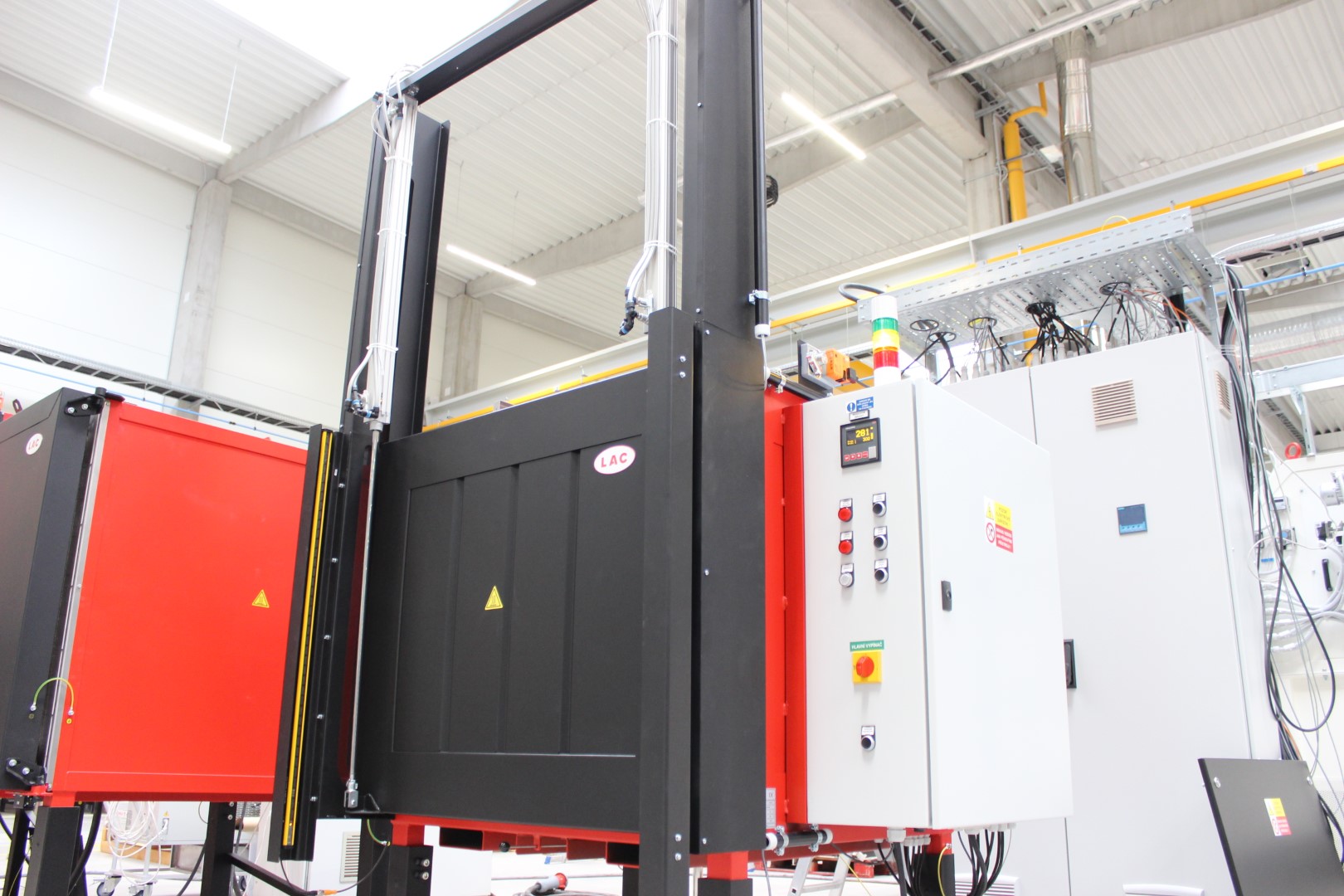
The exact equipment and parameters must be confirmed for the selected model and process specification.
A standard oven cannot simply be fitted with an arbitrary exhaust system at a later date and then be assumed to meet the requirements of the standard.
Circulation, exhaust and cooling are not the same
The word “fan” may appear several times in a quotation, but the individual fans can perform very different functions.
| Function | Purpose |
|---|---|
| Circulation fan | Moves heated air around the load inside the oven. |
| Exhaust fan | Removes part of the internal atmosphere and the released substances from the working space. |
| Forced-cooling fan | Introduces cooler air during the cooling stage of the programme, if the equipment has this function. |
Air circulation inside the chamber does not replace the controlled extraction of flammable vapours. Likewise, a more powerful exhaust fan without the necessary control interlocks, monitoring and heating capacity does not provide a complete safety solution.
The maximum quantity matters, not the normal average
For the equipment design, it is not enough to say that “only a small amount of thinner remains on each component”. The highest realistically possible quantity of flammable substance that may be released during a cycle must be established.
The amount released can change, for example, when:
- more products are placed in one batch,
- the products enter the oven sooner after painting,
- the coating is thicker than usual,
- a hollow product retains cleaning agent,
- products with different degrees of pre-drying are loaded together,
- the substance is released rapidly during one short stage of the programme.
Design for the maximum foreseeable condition
In LAC documentation, the maximum permissible amount of released flammable substance is specified according to the particular oven size and process temperature. A value applicable to one model, temperature and configuration must not be transferred to another oven or process.
A safety data sheet is the starting point, not the complete specification
A safety data sheet helps establish whether a product contains flammable components and what hazards are associated with them. However, it does not tell the furnace manufacturer how much of the product will actually be introduced in one load or how quickly it will be released during your programme.
In addition to the safety data sheet, provide:
- how much of the product is applied to one component,
- how many components are included in the largest load,
- how long the products are allowed to ventilate before entering the oven,
- the maximum residual quantity that may enter the oven,
- the temperature and stage of the cycle at which the substance is released,
- whether several different substances are released from one product.
If you do not know the release rate, say so clearly. This is a better starting point than an unsupported estimate. The necessary information can then be discussed with the chemical supplier and the process engineer.
Common misconceptions that can lead to the wrong order
“The drying temperature is low, so there is no risk”
A low operating temperature does not in itself rule out the release of flammable vapours. The properties of the substance and its behaviour during the specific process are what matter.
“The product is no longer wet”
A surface that feels dry does not prove that no volatile flammable substance remains in the coating, joint, cavity or pores.
“The oven has air circulation, so it will remove the vapours”
Circulation moves the internal atmosphere through the working space. An exhaust system removes it from the oven in a controlled manner. These are two different functions.
“We can add an exhaust fan later”
An EN 1539 configuration is a system of interconnected design, control and monitoring measures. An isolated modification that does not assess the system as a whole may not provide the required level of safety.
“We will calculate it using the average batch”
The safety specification must be based on the maximum foreseeable load and a realistic adverse condition, not on the average production shift.
“Once the process has been assessed, it never needs to be reviewed”
Changing the chemical, applied quantity, load size or programme can alter the conditions for which the industrial oven was designed. The change must be reassessed before it is introduced.
An EN 1539 configuration is not automatically suitable for installation in an explosive atmosphere
Two separate questions must be considered:
- Can flammable substances be released inside the industrial oven during the process?
- Will the complete equipment be installed in an area with a potentially explosive atmosphere?
A configuration designed for a process covered by EN 1539 does not automatically mean that the equipment is suitable for installation in any potentially explosive atmosphere.
The standard LAC SV Mk.II design is explicitly identified in the datasheet as a non-Ex configuration and is not intended for areas with a risk of explosion. If the installation area is classified as a hazardous zone, the customer must state this in the initial enquiry and the suitability of the complete solution must be assessed separately.
What to include in your enquiry
The more complete the input information, the lower the risk that an important safety requirement will only be identified after the equipment has been ordered.
- a description of the product and the purpose of the process,
- the component material and dimensions,
- the name of every paint, adhesive, impregnation resin, oil or cleaning agent used,
- current safety and technical data sheets for all products used,
- the applied quantity and maximum residual quantity per component or load,
- the maximum number of components and total load weight,
- the operating temperature, heating rate, holding time and complete programme,
- the time between applying the product and loading the components into the oven,
- information about the expected substance-release profile, if available,
- the required production capacity and number of cycles per shift,
- the loading and handling method,
- whether the installation area is classified as a potentially explosive atmosphere,
- the required documentation and internal safety regulations.
Do not provide only the current average. The enquiry must describe the maximum condition that can occur during the planned operation.
Three situations and the correct next step
You are drying components that contain only water
Specify the source and quantity of moisture, required drying time, temperature and load size. An EN 1539 configuration may not be necessary because of the water alone, but moisture removal, airflow and any other process hazards still need to be addressed.
The load may release solvents or other flammable substances
Do not order an industrial oven based only on the catalogue dimensions. Provide LAC with the relevant safety data sheets and the maximum quantity of substances in the load, and request an assessment of the configuration for the specific process.
You do not know what remains in the product after the previous operation
First obtain the necessary information from the chemical supplier and process engineer. An unknown quantity cannot be treated as zero when designing the equipment.
Explore LAC industrial ovens
👉 View the LAC SV Mk.II chamber dryer with EN 1539 safety equipment
A safe industrial oven begins with an accurate description of the load.
If you are loading painted, bonded, impregnated, degreased or otherwise chemically treated components, state this in your first enquiry. Based on the specific information provided, LAC can assess whether a standard industrial oven is sufficient or whether a configuration designed to meet EN 1539 requirements is needed.
What to remember
The question “Do we need an EN 1539 configuration?” cannot be answered reliably from the process name, chamber volume or operating temperature alone.
The answer depends on whether flammable substances are released during heating, the maximum quantity involved, the complete cycle and the environment in which the equipment will operate.