
Forced Circulation or Radiant Heating?
Forced Circulation or Radiant Heating?
How to choose the heating method according to the load and process, not just the temperature
The key principle:
Forced circulation is not automatically the better option, and a higher maximum temperature does not automatically make a radiant-heated furnace more suitable. The right choice depends on the load, process and required result.
You need to process metal components at 750 °C. In terms of temperature, both a tempering furnace with forced circulation and a chamber furnace without a circulation fan may appear suitable. Which one should you choose?
The operating temperature alone is not enough to make this decision. You need to consider whether a large number of components must be heated quickly and uniformly by a circulating atmosphere, or whether you are working at higher temperatures and require a chamber furnace heated by elements installed in its walls or floor.
The weight and arrangement of the load, required temperature tolerance, process atmosphere and substances released from the products are also important.
What does radiant heating mean in this article?
In practice, heat is not transferred inside a furnace by just one mechanism. Thermal radiation, natural convection within the furnace atmosphere and heat conduction through the product may all occur simultaneously.
How the terms are used here
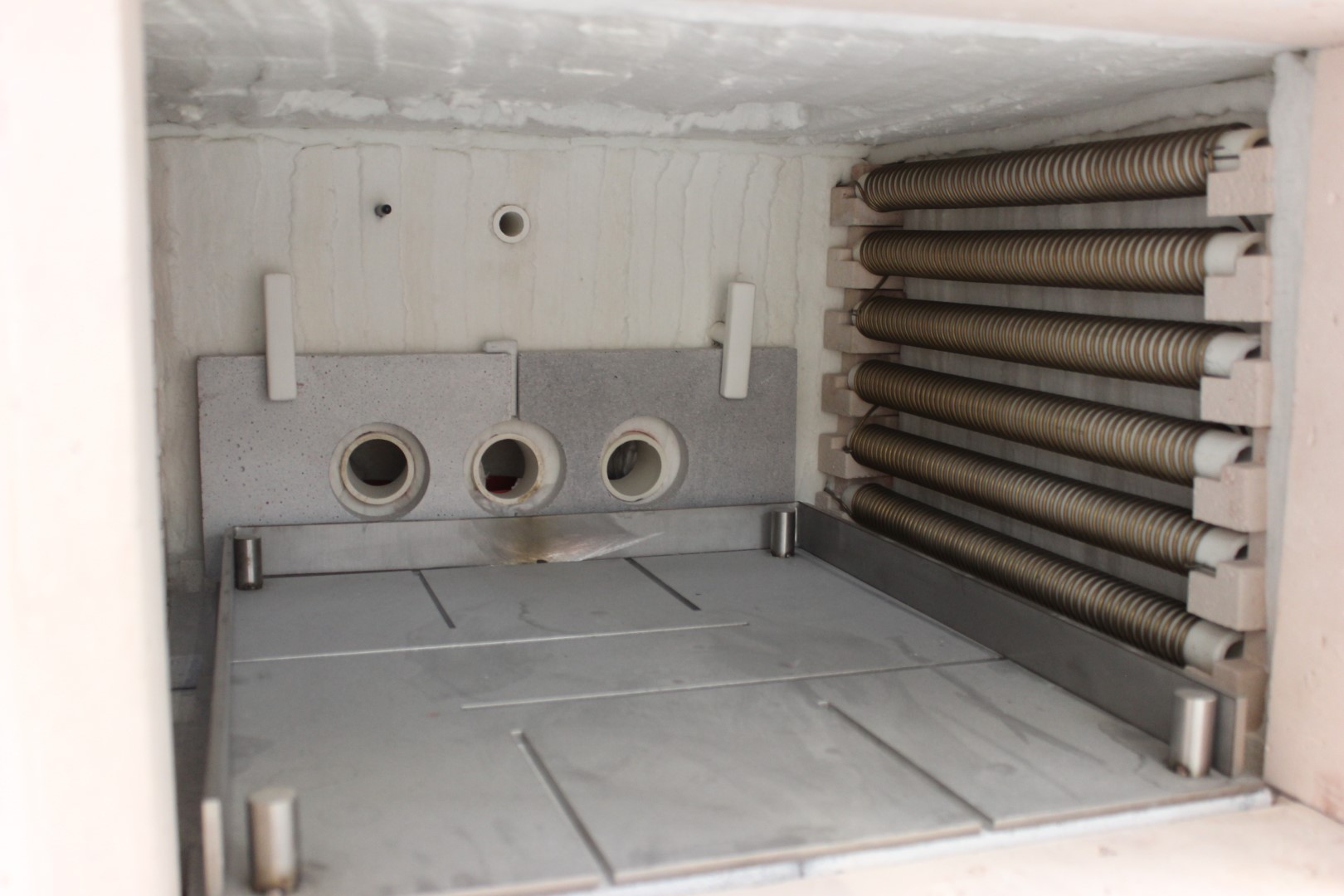
Radiant heating refers here to a furnace without fan-assisted circulation of its internal atmosphere. Heating elements are installed inside the furnace chamber or lining, and the load receives a substantial proportion of its heat through radiation from the heating elements and heated internal surfaces.
Forced circulation means that a fan repeatedly moves the internal atmosphere around the heating elements and through the working space.
For example, LAC PK chamber hardening furnaces have heating coils installed on the sides and in the floor. Smaller PKE furnaces use replaceable heating panels on two sides and in the floor. Neither design has an internal circulation fan.
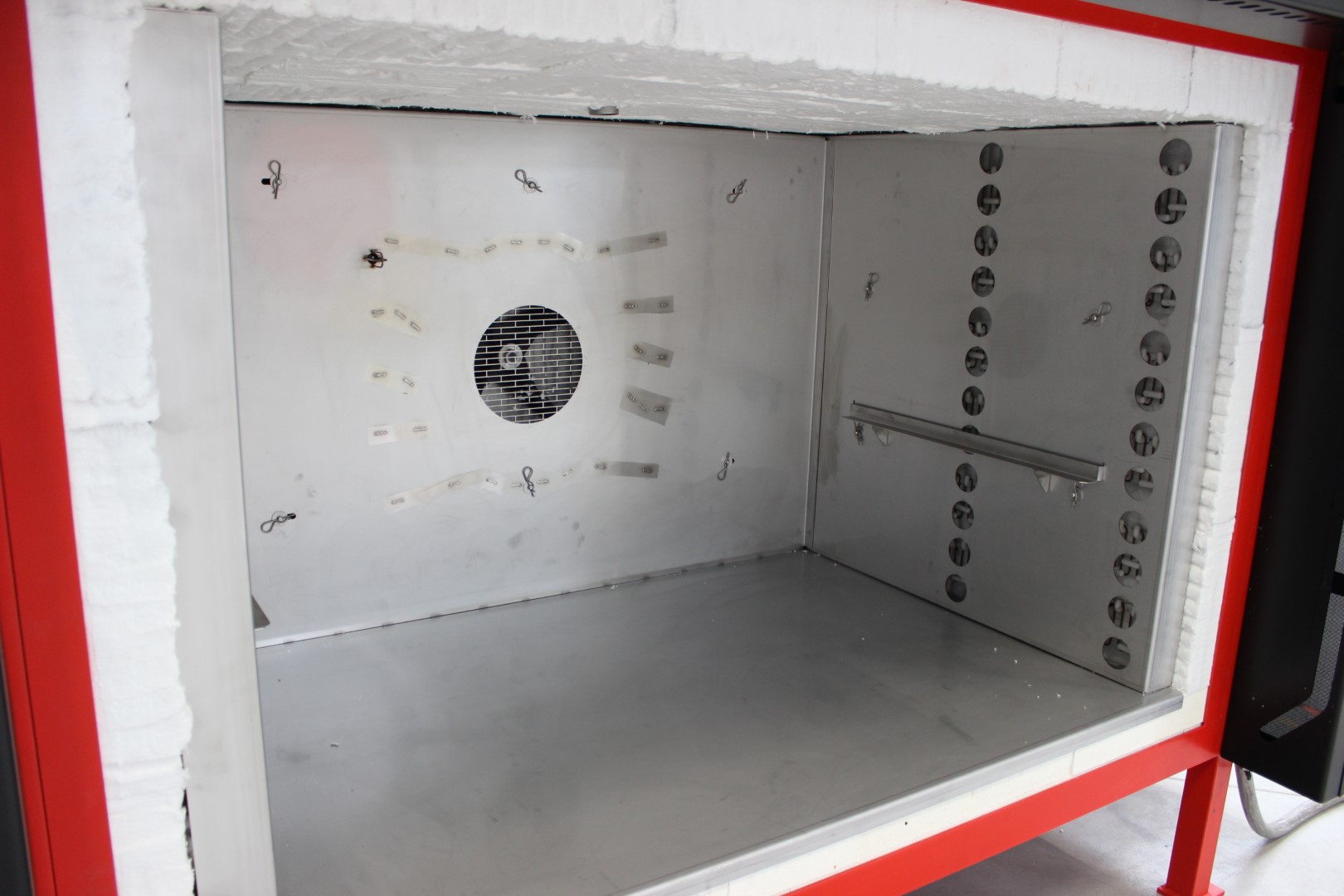
In a furnace with forced circulation, the heated atmosphere transfers heat to the surfaces of the products, while a circulation liner or distribution channels direct its flow.
What do you actually need the furnace to do?
| Customer requirement | Common direction for the solution | What still needs to be verified |
|---|---|---|
| Good temperature distribution at low and medium operating temperatures | Furnace with forced circulation | Required tolerance, usable space, loading arrangement and measurement conditions |
| Processing above the temperature range of a suitable circulation furnace | Chamber furnace or another high-temperature furnace without forced circulation | Operating range of the specific series, holding time and temperature field |
| Faster heat transfer to the surface of a complex or high-volume load | Forced circulation may be beneficial | Whether products and fixtures obstruct the airflow |
| Heavy components that must reach the required core temperature | The complete process determines the solution, not the heating method alone | Weight, thickness, holding time and method used to verify product temperature |
| Protection of product surfaces against oxidation | Furnace designed for a protective atmosphere or equipped with a gastight retort | Gas type, tightness, gas consumption and process safety |
| Removal of moisture, vapours or flammable substances | Ventilation and exhaust designed for the specific process | Composition and quantity of released substances and, where applicable, EN 1539 requirements |
Protective atmosphere and heat-transfer method are two separate decisions. A protective atmosphere can also be forcibly circulated inside certain gastight furnaces.
When does forced circulation make sense?
Forced circulation is useful when moving air or another internal atmosphere must transfer heat efficiently to the load surface and help equalise the temperature within the working space.
A typical example from the LAC portfolio is the PP tempering furnace series with maximum temperatures of 650 or 850 °C. The internal atmosphere flows horizontally: a fan moves it around the heating elements, through circulation liners and into the working space before drawing it back again.
The datasheet lists forced circulation, effective heat transfer into the load and uniform temperature distribution among the principal characteristics of this series.
The same principle is also used in larger equipment. VKNC bogie-hearth furnaces use vertical circulation. A fan moves air along the furnace walls, past the heating meanders, while a circulation liner distributes it through the furnace space. SVH chamber dryers use a fan together with distribution channels on the sides.
Forced circulation is particularly relevant when you:
- process multiple components in a single batch,
- need to reduce temperature differences between individual positions within the usable space,
- operate at temperatures covered by the recommended operating range of the relevant circulation furnace,
- need to transfer heat across a large product surface or into a complex load,
- require a repeatable loading arrangement and consistent batch performance.
A specific temperature-uniformity value cannot, however, be determined solely from the presence of a fan. It must be defined for a particular furnace, usable space, temperature and set of measurement conditions.
A fan cannot help if the air has nowhere to flow
A furnace with forced circulation is designed around a particular airflow path. If this path is obstructed by the load or fixtures, some of the benefit provided by the fan is lost.
This is why the shelves in PP tempering furnaces are perforated and do not extend all the way to the rear wall. The gap behind them is necessary for air circulation. Loading arrangements in other circulation furnaces require similar attention.
When designing the load arrangement, verify:
- where the atmosphere enters the usable space and where it returns,
- whether products obstruct the intake or discharge areas,
- whether sufficient gaps remain between the components,
- whether solid trays, baskets or heavy fixtures create enclosed areas,
- whether the same loading arrangement will also be maintained during normal production.
A more powerful fan cannot correct an unsuitable loading arrangement on its own. The airflow design, load dimensions and load position must work together as a complete system.
When is a furnace without forced circulation appropriate?
A chamber furnace without a circulation fan can be used for processes such as hardening, annealing or preheating metal loads at higher temperatures. The LAC PK and PKE series have a maximum temperature of 1280 °C and a recommended operating temperature range of 700–1200 °C.
This design can be suitable when:
- the required operating temperature exceeds the capabilities of an appropriate forced-circulation furnace,
- the process corresponds to the intended application of the particular chamber furnace,
- the load arrangement allows the products to receive heat from the heated sides,
- the customer does not require or cannot use fan-assisted circulation,
- the required temperature field can be achieved through the furnace design, heating-element arrangement and suitable loading.
No fan does not mean no temperature verification
According to the relevant datasheets, LAC can provide options such as temperature-field optimisation according to DIN 17052-1 and a measurement report for PK and PKE furnaces. The measurement conditions and achievable values must be assessed for the specific configuration.
Nor does radiant heating automatically heat a heavy component through more quickly. The required heat-through time depends on the material, thickness, weight, initial temperature, furnace power, loading arrangement and programme profile.
Example: two furnaces reach 750 °C but are not interchangeable
At an operating temperature of 750 °C, the customer may find that several furnace series overlap.
PP tempering furnace: Tmax 850 °C, recommended operating range 300–800 °C, forced circulation.
PK / PKE hardening furnace: recommended operating range 700–1200 °C, heating from three sides, without a circulation fan.
Does this mean that any of these furnaces can be used for every process at 750 °C? No.
For tempering a larger number of components where airflow around the load and good temperature distribution are important, a PP furnace may be the appropriate direction.
For another high-temperature process, an intermediate heating stage or a requirement extending beyond the temperature capabilities of the PP series, a PK or PKE furnace may be more suitable. The final selection will also depend on the load weight, required tolerance, process atmosphere, cycle frequency and handling method.
The same operating temperature can be associated with very different processes and furnace designs. This is why an enquiry should not consist solely of the phrase “a furnace for 750 °C”.
Circulation is not the same as ventilation or forced cooling
Three functions that may sound similar perform different tasks:
| Function | What it does |
|---|---|
| Circulation | Repeatedly moves the internal atmosphere through the working space. |
| Ventilation and exhaust | Introduce or remove air and substances from the furnace. |
| Forced cooling | Shortens or controls the cooling stage of the cycle, depending on the furnace design. |
The circulation fan alone does not provide the safe removal of solvents, oils or other flammable substances. If the load releases any substances during heating, their composition and maximum quantity must be specified.
Depending on the process, a specially designed industrial oven and an assessment of EN 1539 requirements may be necessary. This topic will be covered in the next article in the series.
What about a protective atmosphere?
The choice between air and a protective gas must not be hidden within the question of circulation. Both air and a protective atmosphere can be forcibly circulated, provided that the furnace is designed for this purpose.
For example, LAC offers PKRC, PZ and SRC gastight furnaces with internal atmosphere circulation. Their purpose is not only to transfer heat but also to maintain a defined environment inside the retort.
A standard furnace with air circulation, on the other hand, does not automatically protect the product surface against oxidation.
Always state in your enquiry whether the process can take place in air or requires nitrogen, argon, forming gas or another atmosphere. The gas type and associated safety conditions must be assessed from a technical perspective.
Common selection mistakes
“A fan guarantees the same temperature in every product”
It does not. A fan helps distribute the atmosphere and transfer heat, but the result is still affected by the weight, geometry and arrangement of the load. The required uniformity must be defined and, where necessary, verified by measurement.
“A higher maximum temperature means a more versatile furnace”
A furnace with a Tmax of 1280 °C can reach 750 °C, but for certain processes at this temperature, a furnace series with forced circulation may be more suitable. The operating range and process determine the correct choice, not the highest number in the table.
“Circulation also removes all process emissions”
Circulating the atmosphere inside the furnace is not a substitute for ventilation, exhaust or an appropriate safety design for processes involving flammable substances.
“The chamber dimensions are all we need to know”
In a circulation furnace, the usable space and preservation of the designed airflow paths are essential. A product may physically fit inside the chamber and still be too large or unsuitable for the proposed loading arrangement.
What to include in your enquiry
To help determine whether you need forced circulation or a furnace without a fan, provide:
- the name of the process and required result,
- the product material,
- the operating temperature, holding time and complete temperature programme,
- the dimensions and weight of one component and the complete load,
- the number of components and a drawing or photograph of the loading arrangement,
- the material, dimensions and weight of baskets, shelves and fixtures,
- the required temperature tolerance and the space across which it must apply,
- whether the process requires air, a protective atmosphere or a retort,
- all substances released during heating,
- the required production capacity and number of cycles per shift.
If you are unsure about the airflow, test the representative load
If you are unsure whether the airflow around a particular load will be sufficient, testing can be arranged at the LAC testing centre. A trial with a representative load can demonstrate its heating behaviour and help refine the technical specification.
Explore LAC industrial furnaces and process testing
Do not choose a fan. Choose the required process result.
Describe the product, load, operating temperature, required temperature tolerance, process atmosphere and production cycle. This information makes it possible to determine not only the heating method but also the necessary usable-space dimensions, power, control system, handling method and measurement equipment.
What to remember
Forced circulation transfers heat through a moving atmosphere and can help improve temperature distribution within the working space. A chamber furnace without a circulation fan enables processes and temperature ranges for which a circulation furnace may not be designed.
Do not begin with the question “Should the furnace have a fan?” Begin with the load, required result and complete operating cycle.